



News
December 2025
🎵 We wish you rewetted peatlands
by Berit Krondorf (comments: 0)
… and a Happy New Year!
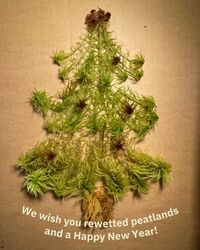
22/12/2025 This is our peatland twist on the classic Christmas jingle. We send it to all peatland lovers and hope for it to become as true as possible in 2026.
As 2025 comes to a close, we want to thank all our friends, followers, and partners for your support of the Greifswald Mire Centre. Together, we’ve made strides in peatland protection, research, and advocacy. Here’s to even more impactful collaborations and dedicated peatland action in 2026! ✨
Paludiculture Newsletter
by Berit Krondorf (comments: 0)
Fresh issue
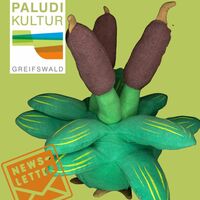
17 December 2025 The new Paludiculture Newsletter 4|2025 is here! These are our topics:
- Cuddling with peatland: Artist Daniel Hengst creates textile peatland plants that embody paludiculture
- Peatlands post-COP30: What was achieved for peatlands at the World Climate Conference in Belém and what are the prospects for upcoming COPs? Assessments by Franziska Tanneberger
- From peatland to market: Clemens Kleinspehn analyses the environmental impact of a paludiculture product over its entire life cycle. Why this is important? Read the interview!
- Anti-mud mats from peatlands – paludiculture biomass helps at the Wacken Festival
- Sneak peek at PaludiScout: The central platform for specialised technology for managing wet areas will launch soon.
- Opening: The Peatland Library in Greifswald now has a new home – find out more about this repository of knowledge and meeting place.
Plus: more topics and current dates in the event calendar!
We enjoy staying in touch with our readers. What topics would you like to see covered in the Paludiculture Newsletter, and what feedback do you have for us? Feel free to email us at communication@greifswaldmoor.de.
New resilience check for Germany
by Berit Krondorf (comments: 0)
with paludiculture and agrivoltaics/peatland PV
11/12/2025 In its latest resilience dossier, the Office of Technology Assessment at the German Bundestag (TAB) informs members of parliament about possible developments in ‘water management in agriculture’ in future scenarios up to 2050. It also covers the potential of new forms of use, such as agrivoltaics, peatland-photovoltaics and paludiculture on rewetted and previously drained agricultural land (link to the dossier in german).
The dossier considers agrivoltaics and peatland PV to be particularly promising. It states that partial shading by PV modules could reduce evaporation and thus conserve water resources. Furthermore: ‘For peatland-photovoltaics (peatland PV) ... an estimated technical potential of 440 to 880 GWp is assumed in Germany. This corresponds to approximately four to eight times the photovoltaic capacity currently installed in Germany and illustrates the enormous energy potential of this use.’ However, our knowledge of the effects of peatland PV is still limited, and further research is needed before large-scale implementation can be recommended. Projects such as MoorPV and MoorPower are currently conducting research about it.
The dossier assesses paludiculture as follows: ‘Agriculture on rewetted peatland areas with peat conservation, known as paludiculture, therefore still occupies a niche position ... However, this could change by 2050 due to the great potential for climate protection.’ Prof. Dr. Gerald Jurasinski, Carl Pump and Dr. Wendelin Wichtmann contributed their expertise to the dossier.
About the resilience dossiers:
The resilience check and the resulting dossier are a consulting service for the German Bundestag and serve as background information for specialist committees, as well as for social actors and the public. It analyses the potential of scientific and technological developments and discusses their possible impact on society. It discusses on an infrastructure-related topic each year. The 2026 edition of the Resilience Check will concentrate on ‘Cybersecurity in Research’.